

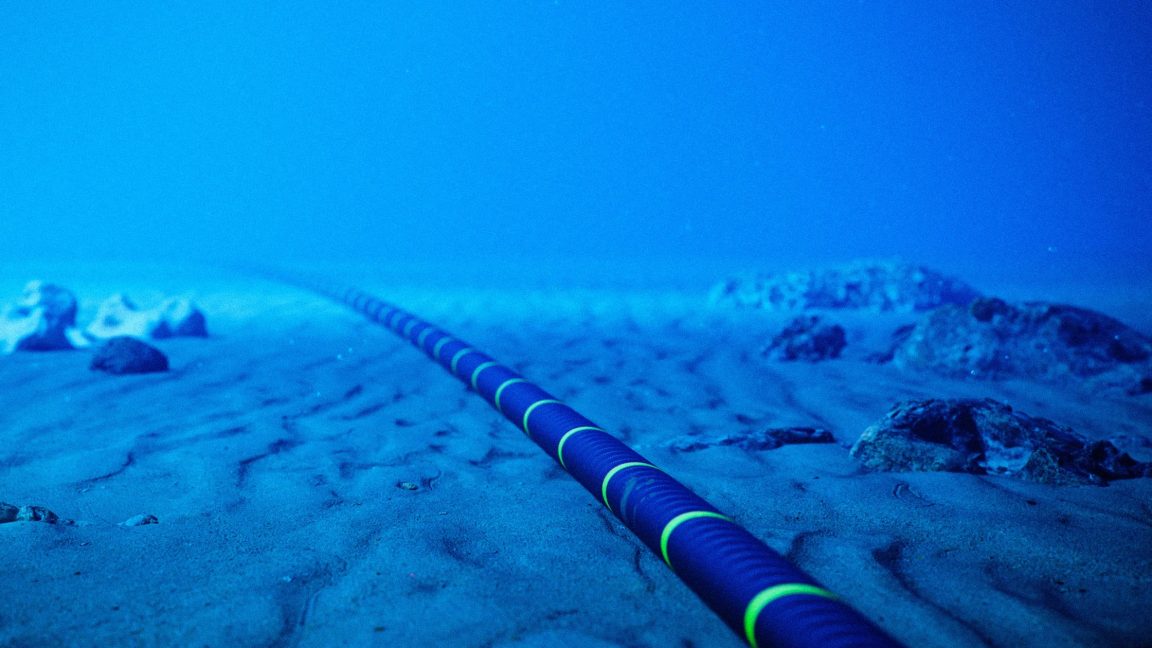
A Chinese research vessel has successfully tested a new device designed to slice through submarine data cables located thousands of meters beneath the ocean's surface. This demonstration is likely to intensify security concerns following several suspected sabotage incidents targeting undersea communications and power cables across various regions, from the Baltic Sea to the Pacific Ocean.
The test occurred at an impressive depth of 11,483 feet (3,500 meters) during a scientific expedition led by the Chinese ship Haiyang Dizhi 2. This vessel is equipped with advanced technology, including a 150-ton crane and a 10-kilometer fiber optic winch, allowing for the deployment of deep-sea remotely operated vehicles in previous missions.
According to reports, the sea trial has marked a significant step forward in the transition from deep-sea equipment development to practical engineering applications. This advancement is part of a broader trend in which Chinese military and civilian organizations have developed various dual-use technologies for cutting undersea cables over the years. Notably, the People’s Liberation Army has patented tools specifically designed for cable-cutting and retrieval, alongside academic institutions like Lishui University, which has developed devices intended for emergency cable-cutting operations.
Mechanics of the Cable-Cutting Technology
The newly developed cable-cutting technology is engineered to operate at maximum depths of 13,123 feet (4,000 meters). The design was first detailed in the Chinese-language journal Mechanical Engineer, attributed to researchers at the China Ship Scientific Research Center and the State Key Laboratory of Deep-sea Manned Vehicles.
This innovative technology utilizes an electro-hydrostatic actuator composed of a hydraulic pump, an electric motor, and a control unit. This compact mechanism allows a diamond-coated grinding wheel to exert sufficient force to sever undersea cables, which are typically reinforced with layers of steel, rubber, and polymer. The small size of this device enables it to be integrated into China's numerous underwater remotely operated vehicles.
The recent demonstration of this deep-sea cable-cutting technology has been interpreted as a display of strength by analysts. Experts have noted that while China publicly denies involvement in dubious operations concerning altered anchors, the unveiling of equipment capable of cutting fortified cables sends mixed signals regarding its intentions in global submarine infrastructure.
China's ambitions extend beyond mere demonstration; it aims to establish itself as a significant player in the construction and operation of global submarine cables while simultaneously signaling its capability to disrupt critical infrastructure when necessary.
Global Implications and Concerns
While China is not the only nation with the technological capacity to access and potentially sever undersea cables, its actions raise alarms. Historically, during the Cold War, the U.S. Navy employed modified submarines and divers to tap into Soviet naval communications via undersea cables. Today, both the U.S. and Russia operate nuclear submarines and survey ships capable of accessing these vital infrastructures.
Chinese researchers assert that the cable-cutting technology is intended for civilian marine resource development. However, speculation suggests that it could threaten the fiber-optic cables connecting Pacific islands such as Guam, a U.S. territory hosting military bases. The presence of such capabilities could escalate Chinese military pressure on Taiwan, which relies heavily on undersea cables for global connectivity and has faced numerous suspected sabotage incidents linked to Chinese-operated vessels.
In recent months, Chinese-flagged cargo ships have been implicated in damaging undersea data cables and gas pipelines in the Baltic Sea, affecting several European nations. These incidents have been described by Chinese officials as accidents, but they contribute to a growing pattern of concerns surrounding potential sabotage.
The emergence of this cable-cutting technology serves as a stark reminder of the vulnerabilities inherent in the Internet's physical backbone, which comprises over 1.5 million kilometers of submarine cables connecting continents. As nations continue to invest in capabilities that can disrupt these connections, global reliance on undersea communications becomes increasingly precarious.
Source: Ars Technica News